
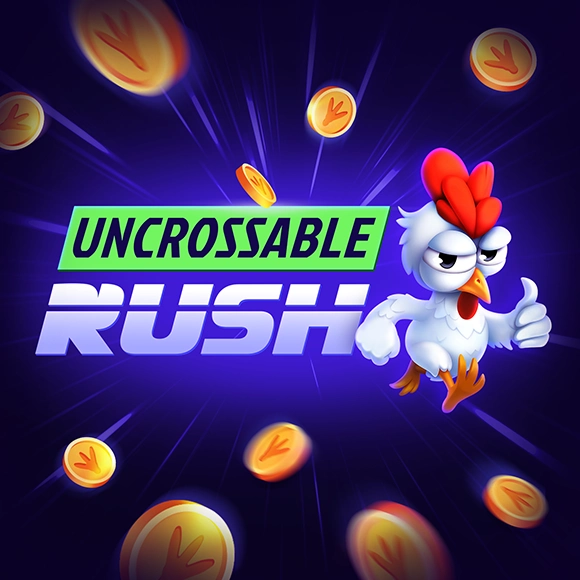
| Detail | Information |
|---|---|
| Provider | Evoplay |
| Game type | Crash-style road-crossing casino game |
| Core mechanic | CrossyRun |
| Release date | June 2025 |
| RTP | 96% |
| Max multiplier | 10,000x |
| Min bet | 0.1 |
| Max bet | 75 |
| Main character | Eggwina the chicken |
| Road layout | 24 traffic lanes |
| Difficulty levels | Easy, Medium, Hard, Hardcore |
| Cash-out style | After each successful lane |
What Is the Uncrossable Rush Game?
Basic game concept
The title is an instant casino game from Evoplay where a chicken named Eggwina tries to cross a busy road. Each safe lane increases the possible payout, and the player can stop after a successful move. The idea is simple, but the pressure rises because every extra step carries more risk.
How it differs from classic slots
The Uncrossable Rush slot label appears on some casino pages, but the format is not a normal reel game. There are no paylines, spinning reels, or scatter-triggered free spins. Instead, the round feels closer to a crash title, because the player decides whether to keep going or take the current multiplier. The game still uses RNG logic, so timing skill does not control the result.
Who this game may suit
The Uncrossable Rush crash game may suit players who prefer quick decisions over long bonus features. It is easier to read than many feature-heavy slots, and the cash-out point stays visible. Players who dislike sudden losses may prefer Easy mode or free play. Indian users should remember that real-money online gaming rules changed sharply in 2025.
Create an AccountMain Gameplay Features
24-lane road-crossing format
Uncrossable Rush uses a 24-lane highway as its round structure. Eggwina moves step by step, and the player sees progress instead of waiting for a reel result. The visual setup is playful, but the risk is still financial where real-money access is permitted.
Rising multiplier after each move
Each successful lane raises the available multiplier. The increase depends on the selected difficulty, so higher-risk modes grow faster. A player can stop early or continue toward a higher number. That choice is the centre of Uncrossable Rush play, not a side feature.
Difficulty levels and risk changes
The four difficulty settings change how often a round may fail and how quickly rewards rise. Easy mode gives more frequent safe moves, while Hardcore mode pushes the largest possible multiplier. This means the risk curve changes before the first move is made.
Manual cash-out decisions
The manual cash-out format is the part many players notice first. After a safe lane, the player can collect or keep moving. It sounds simple, yet fast rounds can make poor choices feel tempting. A fixed stopping point helps keep Uncrossable Rush from turning into impulse play.
How to Play Uncrossable Rush
Step-by-step playing process
A normal Uncrossable Rush play round follows a short set of decisions. The player should read the paytable first, because mode, stake, and cash-out rules shape the session. In India, this process should be used only where local rules allow it. The basic flow is:
- Open the game in demo or real-money mode.
- Choose the stake amount.
- Select the difficulty level.
- Start the round.
- Move Eggwina across the road.
- Cash out after a safe lane or continue for a higher multiplier.
What happens after a failed crossing
When Eggwina fails to cross safely, the active round ends and the stake is lost. The player cannot recover that round by pressing again or changing speed. This is why the format should not be treated like a skill test. The next round is separate and uses a fresh random outcome.
Demo mode versus real-money mode
Demo mode copies the rules of the Uncrossable Rush game without using a paid stake. Real-money mode adds financial pressure, which often changes how a player reacts to losses. In India, the Promotion and Regulation of Online Gaming framework prohibits online money games and related payments, so users should treat free mode as the practical route unless lawful access clearly applies.
See all gamesRTP, Volatility, and Multiplier Potential
What the 96% RTP means
The listed RTP is 96%, which describes a long-term mathematical return across many rounds. It does not predict one session, one stake size, or one player’s result. A short run can end above or below that figure. Uncrossable Rush should be assessed through risk limits, not through expectation of steady returns.
Why volatility changes with difficulty
Volatility is adjustable because the player selects the difficulty mode. Easy mode usually gives more modest growth and a higher chance of short progress. Hard and Hardcore modes raise the reward curve but also make quick failures more common. The same game can therefore feel calm or severe depending on the chosen setting.
Max multiplier and realistic expectations
The maximum multiplier is listed as 10,000x, mainly linked with the highest-risk path. That number is useful for understanding the ceiling, but it should not become a target. Most rounds end far below the top value. A player reading Uncrossable Rush play guides should focus on when to stop, not on rare headline outcomes.
Difficulty Modes Explained
Easy mode
Easy mode is the most forgiving setting. It helps with the lane system, early cash-outs, and calmer testing. The multiplier grows slowly, which makes it the cleanest starting point for cautious users.
Medium mode
Medium mode sits between slow control and larger reward potential. It raises the risk enough to change the feel of each step. Players may try it after Easy mode, but a fixed limit still matters.
Hard mode
Hard mode is built for stronger swings. The multiplier rises faster, but failed crossings become more likely. Uncrossable Rush may suit players who already understand crash-style games, while casual users may find it too sharp.
Hardcore mode
Hardcore mode is the highest-risk option and is linked with the 10,000x ceiling. It can end very quickly, and the larger return potential does not reduce risk. This mode is not ideal for beginners.
The comparison below shows how the four modes change the playing profile. Traffic speed is described in practical player terms. No mode removes randomness.
| Mode | Risk Level | Traffic Speed | Multiplier Growth | Best For |
|---|---|---|---|---|
| Easy | Low | Slower | Gradual, up to about 24x | Learning rules and lower-risk sessions |
| Medium | Moderate | Faster | Balanced, up to about 2,500x | Players who want a middle path |
| Hard | High | Fast | Strong, up to about 5,000x | Short high-volatility sessions |
| Hardcore | Very high | Very fast | Sharp, up to 10,000x | Experienced players chasing the top range |
Benefits and Drawbacks of Uncrossable Rush
Main benefits
The main strengths of Uncrossable Rush are clear after a few rounds. The format avoids complex paytables, makes cash-out visible, and suits short mobile sessions. Key benefits include:
- Simple rules and fast rounds.
- Clear cash-out choice after each lane.
- Four difficulty levels for different risk styles.
- Demo mode for practice.
- Strong mobile-friendly format.
Possible drawbacks
The same speed can become a weakness when a player reacts emotionally. Fast losses may lead to rushed stakes, especially in Hard or Hardcore mode. The main drawbacks are:
- No paylines, reels, or classic slot bonus rounds.
- High-risk modes can end very quickly.
- A large multiplier is rare.
- Results depend on random outcomes, not timing skill.
Mobile Play and User Experience
Browser play on smartphones
Uncrossable Rush is built in HTML5, so it can run through a mobile browser where the game is legally and technically available. This matters because many Indian users rely on phones. The game window is simple, with one character, lane progress, and clear multiplier information.
Touch controls and screen layout
The touch layout supports quick choices, but that can make fast staking too easy. Players should check stake size before starting, especially after changing modes. Good Uncrossable Rush play starts with reading the information panel, not only tapping forward.
Session speed on mobile
Mobile sessions can move faster than expected. A player may complete many rounds in a few minutes and lose track of total spend. Since Indian real-money access is legally sensitive, free play is the safer reference point for most readers.
Uncrossable Rush Demo Mode
Why beginners should test the demo first
Uncrossable Rush demo mode lets a beginner learn the flow without risking a paid balance. It shows how difficulty affects the pace and how often early cash-outs appear. It also shows whether the game feels too quick for personal habits.
What demo mode can teach
Demo play can teach stake selection, mode changes, and cash-out discipline. The player can test conservative stopping points before any paid decision is even considered. In that sense, the format is easy to study before it becomes stressful.
Limits of demo practice
The Uncrossable Rush demo cannot copy the emotions of real-money loss. A player may stay calm with demo credits but behave differently with a real balance. Demo results also do not reveal future paid outcomes.
Real-Money Play and Bankroll Control
Setting a fixed session budget
In India, real-money online games face national restrictions under the 2025 law, and major operators paused money-based features after the change. Payment processing and access may be blocked. Where real-money play is lawful, Uncrossable Rush needs a fixed session budget before the first round.
Choosing stakes based on risk level
Stake size should match difficulty. Easy mode may allow more rounds with the same budget, while Hardcore mode can end a session quickly. The phrase may sound casual, but stake control is the main serious decision.
When to stop a session
A stop point should be set before the session begins. It may be a time limit, a loss limit, or a modest profit target. The Uncrossable Rush crash game format rewards quick decisions, but safe gambling habits need slower thinking.
Make Your Move & Play NowPractical Tips for Safer Play
Use low stakes when testing difficulty modes
Low stakes reduce pressure while the player learns how each setting feels. A higher multiplier curve can look attractive, but it also changes the failure rate. Sensible Uncrossable Rush play starts with the smallest comfortable risk.
Cash out before risk becomes uncomfortable
The cash-out button exists because the next lane is never guaranteed. Players should decide in advance where the round feels “enough.” A calm exit is often better than chasing a number that looked close.
Avoid chasing failed rounds
A failed round is finished. Increasing the next stake to recover it may create a larger loss in less time. The Uncrossable Rush slot label should not make the game seem softer than it is.
Take breaks during fast sessions
Fast rounds can blur together, so breaks are part of basic control. These habits do not improve the odds, but they can reduce rushed decisions. A simple checklist can help:
- Set a time limit before starting.
- Keep the lowest stake while testing a new mode.
- Stop after reaching the planned loss limit.
- Use demo mode after a frustrating paid session.
- Avoid playing when tired, angry, or distracted.
FAQ
Is Uncrossable Rush a slot or a crash game?
It is better described as a crash-style road-crossing casino game. Some sites may group it with slots, but there are no reels or paylines. The player moves across lanes and chooses whether to cash out after safe steps.
Can the Uncrossable Rush game be played for free?
Yes, it can be played in demo mode on sites that provide a free version. Free play is useful for learning the road layout, difficulty modes, and cash-out rhythm. Indian users should prefer free access where real-money gaming is restricted.
What is the RTP?
The listed RTP is 96%. This is a long-term theoretical figure, not a promise for one short session. A player can still lose quickly, especially on high-risk modes.
What is the highest multiplier?
The highest listed multiplier is 10,000x. It is tied to the highest-risk progression, so it should be treated as a rare ceiling. Players should not build an Uncrossable Rush play session plan around reaching the maximum.
Which difficulty mode is best for beginners?
Easy mode is the best starting point for beginners. It gives the player more time to understand the lane system and cash-out choices. For learning, Uncrossable Rush play in demo mode is more useful than starting with Hard or Hardcore.